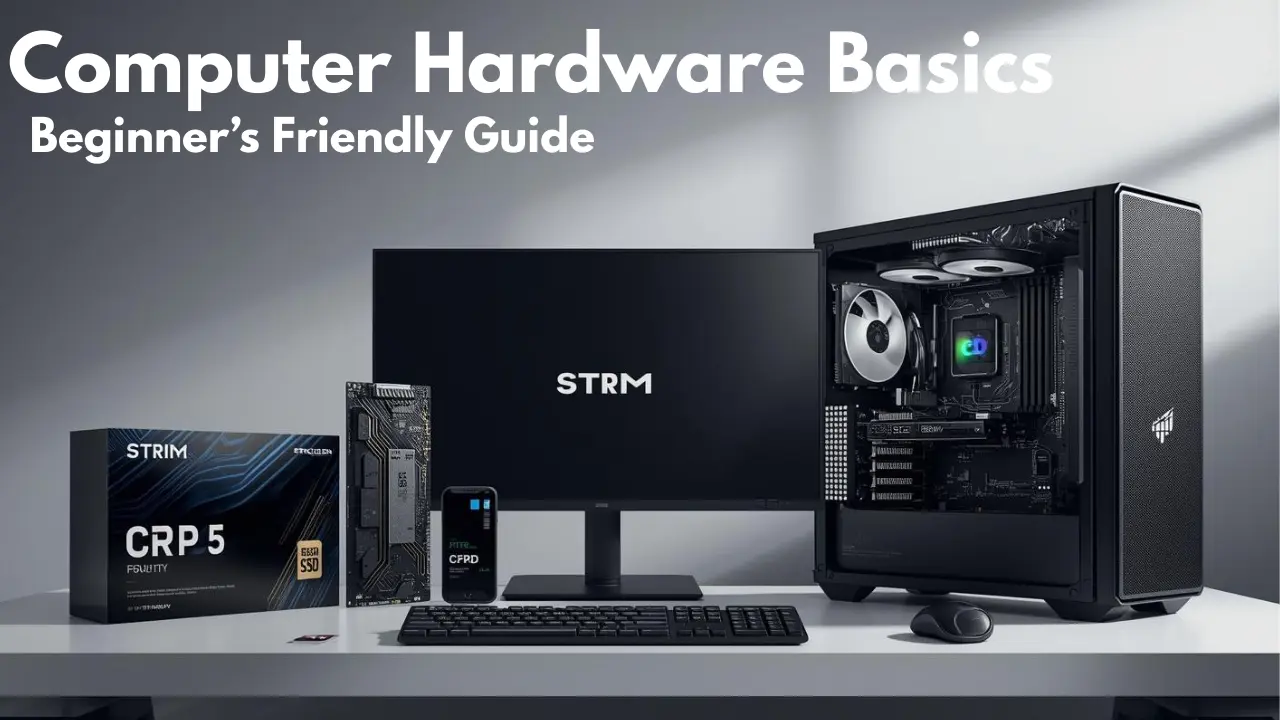
Learn computer hardware basics with real-life examples, hands-on tips, troubleshooting tricks, and beginner-friendly courses & books. A complete guide for anyone starting out in tech.
Ever opened your laptop or desktop and thought, “Wait… what’s actually going on inside this thing?
I still remember the first time I popped open my old laptop—it looked like a jungle of chips, wires, and tiny fans everywhere. Totally overwhelming! That’s when I realized understanding computer hardware basics isn’t just nerd stuff—it actually saves time, money, and a lot of headache.

Think of it this way: software tells the computer what to do, but hardware is the engine that makes everything happen. If you get the hang of these components, you can basic computer hardware and software
- Fix small problems without panicking
- Upgrade your system for better performance
- Choose the right computer for gaming, work, or school
- Build a solid foundation for tech careers
In this guide, I’ll walk you through the main components, share some personal experiences (so you don’t make the same mistakes I did), and give tips most textbooks completely skip. By the end, you’ll understand how hardware and software work together, how to troubleshoot, and what upgrades actually matter.
What is Computer Hardware?

Simply put, computer hardware is everything you can physically touch in a computer. Chips, boards, fans, drives—basically the body of your machine.
Software, on the other hand, is invisible—it’s code, apps, and programs. Without hardware, software is useless.
Why Knowing Hardware Basics Matters Computer Hardware Basics
When I built my first PC, I made a silly mistake: bought incompatible RAM. Took me hours (and money!) to fix it. That’s why learning hardware is key.
Here’s the lowdown:
- Troubleshooting Made Simple: Flickering screens or lag? Usually, one part is the culprit.
- Smart Upgrades: Knowing what each part does helps you spend wisely.
- Understand Performance: Slow software often means hardware is hitting its limits.
- Career Boost: IT, gaming, electronics—hardware knowledge is essential.
Tip: Safely open your laptop or desktop and identify the motherboard, RAM sticks, CPU, and storage. Take a photo; trust me, it helps computer hardware basics
Types of Computer Hardware
Hardware is usually grouped into input, output, and storage devices. Let’s break it down.
Input Devices Computer Hardware Basics
These are what you use to feed data into your computer. My first keyboard was tiny and noisy—switched to a mechanical one, and my typing improved instantly.
- Keyboard: Standard, ergonomic, mechanical
- Mouse: Optical or wireless
- Scanner: Converts paper to digital
- Microphone & Webcam: For calls or streaming
Tip: Play with mouse sensitivity. Find what’s comfortable for you—it’s surprisingly important!
Output Devices
Output devices show the results of your computer’s work.
- Monitor: Displays text, images, videos
- Printer: Produces physical copies
- Speakers/Headphones: For sound
Story: I switched to a 144Hz monitor for gaming, and wow—the difference was night and day. Smooth gameplay, no more stuttering.
Storage Devices
Storage keeps your data safe—temporarily or permanently.
| Device | Type | Pros | Cons |
|---|---|---|---|
| HDD | Magnetic | Cheap, large capacity | Slower |
| SSD | Flash | Fast & reliable | Costlier |
| NVMe | Flash | Ultra-fast | Smaller storage |
| USB/SD | Portable | Easy to carry | Fragile |
Tip: Use SSD for your OS & programs. Keep HDD for movies, backups, and large files.
Story: I swapped my old HDD for an SSD once—boot time dropped from 90 seconds to 20 seconds! Total game-changer.
Essential Computer Components
CPU (Central Processing Unit)

The CPU is basically the brain. It handles instructions, calculations, and keeps everything in sync.
Story: Running multiple apps made my old CPU hit 95% usage. Upgraded it—instant multitasking win.
Tip: Multi-core CPUs are best if you work with video editors, games, or heavy software computer hardware basics
RAM (Random Access Memory)
RAM temporarily stores active data. I noticed Chrome tabs lagging on 4GB RAM. Bumped it to 8GB, and everything felt smoother.
Step Example: Open Task Manager → check RAM usage → consider upgrading if near 100%.
Motherboard
The motherboard connects all components. Fun fact: my first motherboard didn’t fit my new CPU. Lesson learned: always check compatibility.
GPU (Graphics Processing Unit)

GPU handles visuals. Integrated GPUs are okay for casual use. Gamers and designers? You’ll want a dedicated one.
Story: Editing videos lagged like crazy with integrated graphics. Installed a GPU—problem solved.
PSU (Power Supply Unit)
PSU provides stable electricity. Underpowered PSU can cause random restarts—ask me how I know. Always check wattage computer hardware basics
Storage Devices
- SSD = speed
- HDD = capacity
- NVMe = ultra-fast operations
Step-by-Step Troubleshooting
- PC won’t boot: Check PSU, RAM seating, CPU
- Slow performance: Upgrade RAM/SSD, clean malware
- Overheating: Dust fans, reapply thermal paste
- Peripheral issues: Update drivers
Story: My PC overheated just because of dust in the fans. Cleaned it—good as new. Super simple fix!
Recommended Books & Courses
Books:
- Upgrading and Repairing PCs by Scott Mueller
- Computer Hardware Bible by James T. Powell
Courses:
- Coursera: Computer Hardware Fundamentals
- YouTube: Step-by-step PC assembly tutorials
Tip: Mix books with video tutorials—it’s a faster, more practical way to learn.
Beginner Tips
- Start with basic components first
- Hands-on practice is a must
- Join communities like r/buildapc for advice
- Note down every step—you’ll thank yourself later
- Test components individually before full assembly
More Updates Smartbuzzusa
FAQs
Hardware vs Software?
Hardware = physical, software = code
How much RAM do I need?
8GB for beginners, 16GB+ for heavy users
Do I need a dedicated GPU?
Only if gaming or designing
Can I upgrade my CPU?
Yes, check motherboard socket
Fastest storage?
SSD/NVMe
Why does my PC overheat?
Dust buildup, poor cooling