


Russia earthquake tsunami warning has been lifted after a series of strong quakes hit off the Kamchatka coast. Here’s what happened and why the alert was canceled Russia earthquake tsunami warningRussia earthquake tsunami warning
On July 20, 2025, authorities canceled a tsunami warning for Russia’s Kamchatka Peninsula after a series of strong earthquakes near the coast. The biggest quake measured 7.4 on the Richter scale and struck in the early hours, shaking off some nerves but causing no known damage. Russia earthquake tsunami warning Russia earthquake tsunami warning

What Happened?
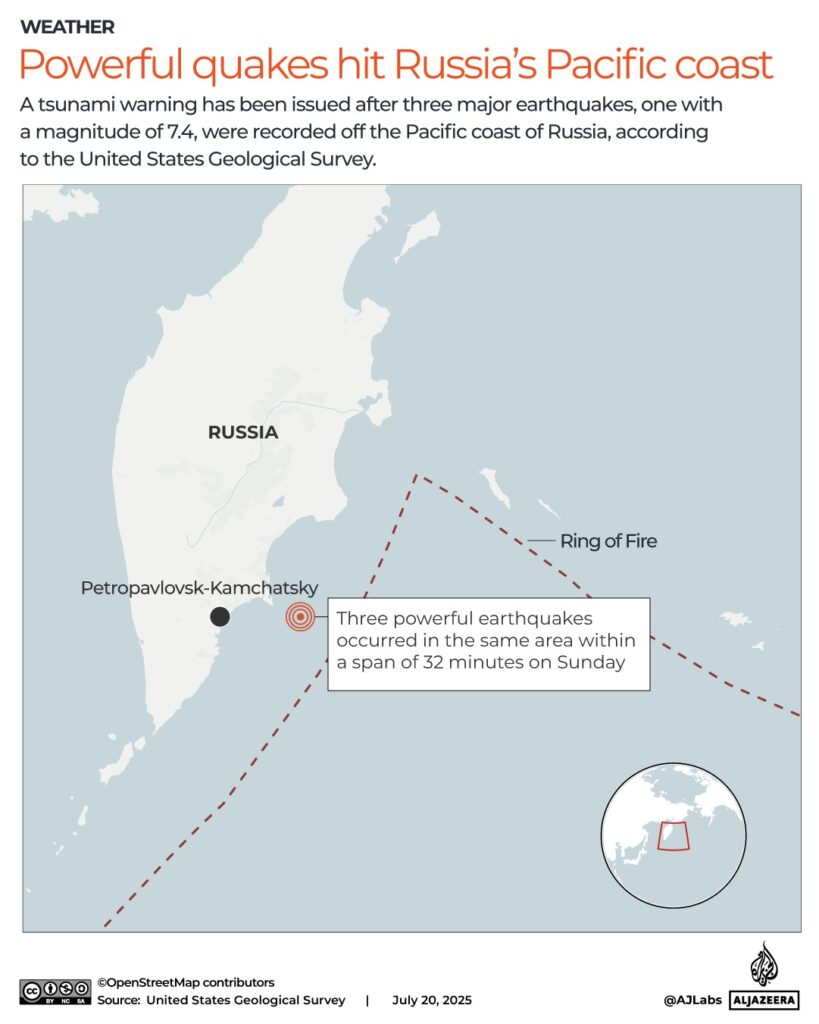
Five major tremors rocked the sea east of Petropavlovsk-Kamchatsky, a city of about 180,000 people. The initial earthquake, magnitude 7.0, hit around 142 km offshore. Within minutes, a 6.7 quake followed, then the big one of 7.4, and after that, another 6.7 and a 6.6. Smaller tremors followed as well.
Tsunami Alert Issued – and Then Cancelled
Immediately after the quakes, both the Pacific Tsunami Warning Center (PTWC) and Russia’s Emergency Ministry warned coastal communities. The message was clear: stay away from the shore, don’t watch from piers or beaches.
However, the alerts came down quickly—within a couple of hours, officials confirmed the tsunami threat was over. The waves, even those that did form, were expected to stay under one meter—too small to cause real harm.
Expected Wave Heights By Region
Regional authorities gave rough estimates of the possible wave heights:
- Aleutian Islands region: Up to 60 cm
- Ust-Kamchatsky: Up to 40 cm
- Petropavlovsk-Kamchatsky: Up to 15 cm
These small heights meant no evacuations were needed, and authorities confirmed there were no casualties or structural damage.
Ripples Felt Around the Pacific
The tremors also triggered a tsunami watch in Hawaii, Japan, and near Midway Atoll. Hawaii’s emergency department posted notices urging people to be prepared but stressed the situation was under close review.
“Tsunami Watch Issued – Prepare to Act! A Tsunami Watch means a tsunami is possible, but the situation is still being evaluated,” they said. Within hours, the watch was lifted with no reported impact.
A Quick History Lesson
This wasn’t Kamchatka’s first brush with a big quake. In 1952, the region experienced a 9.0 magnitude megathrust quake that triggered a tsunami reaching 30 feet (9.1 m) in parts of Hawaii. Fortunately, no fatalities were recorded.
That event left a lasting impression, leading to better monitoring and warning systems across the Pacific—ones that likely prevented harm this time around.
Why No One Got Hurt
Several factors helped avoid a disaster in 2025:
- Deep epicenter – The quake occurred 20 km beneath the surface, reducing coastal shaking and wave size.
- Early alerts – Authorities issued warnings within minutes. People stayed off beaches and piers.
- Effective communication – Agencies in both the U.S. and Russia shared reliable seismic data.
- Smaller wave forecasts – Predictions stayed under evacuation thresholds, preventing panic.
What This Means Going Forward
This event highlights the importance of strong seismic networks and international cooperation. The PTWC, USGS, and local agencies worked smoothly together. Quick alerts and transparent information helped communities stay safe.
Residents learned once again that even strong quakes don’t always mean disaster—but staying alert and informed pays off.
Key Takeaways
- Five tens-of-kilometers offshore earthquakes hit near Kamchatka, with the largest at magnitude 7.4.
- Tsunami warnings in Russia and Hawaii were issued and canceled within hours.
- Expected waves were small (15–60 cm), causing no evacuations or damage.
- Past events, deep focus points, and solid response systems helped avoid a crisis.
Russia Earthquake Tsunami Warning Lifted After Pacific Coast Rattled by Strong Quakes
Russia earthquake tsunami warning was briefly issued on Sunday, July 20, 2025, after multiple powerful earthquakes struck off the Kamchatka Peninsula in Russia’s Far East. The alert caused brief concern across the region and in parts of the Pacific, including Hawaii, but was lifted within hours.
According to the U.S. Geological Survey (USGS), the largest quake registered magnitude 7.4, occurring 144 km east of Petropavlovsk-Kamchatsky, a coastal city home to 180,000 people. The quake’s depth was measured at 20 km, which is considered shallow and more likely to trigger tsunamis.
More updates Smartbuzzusa